
Identify first
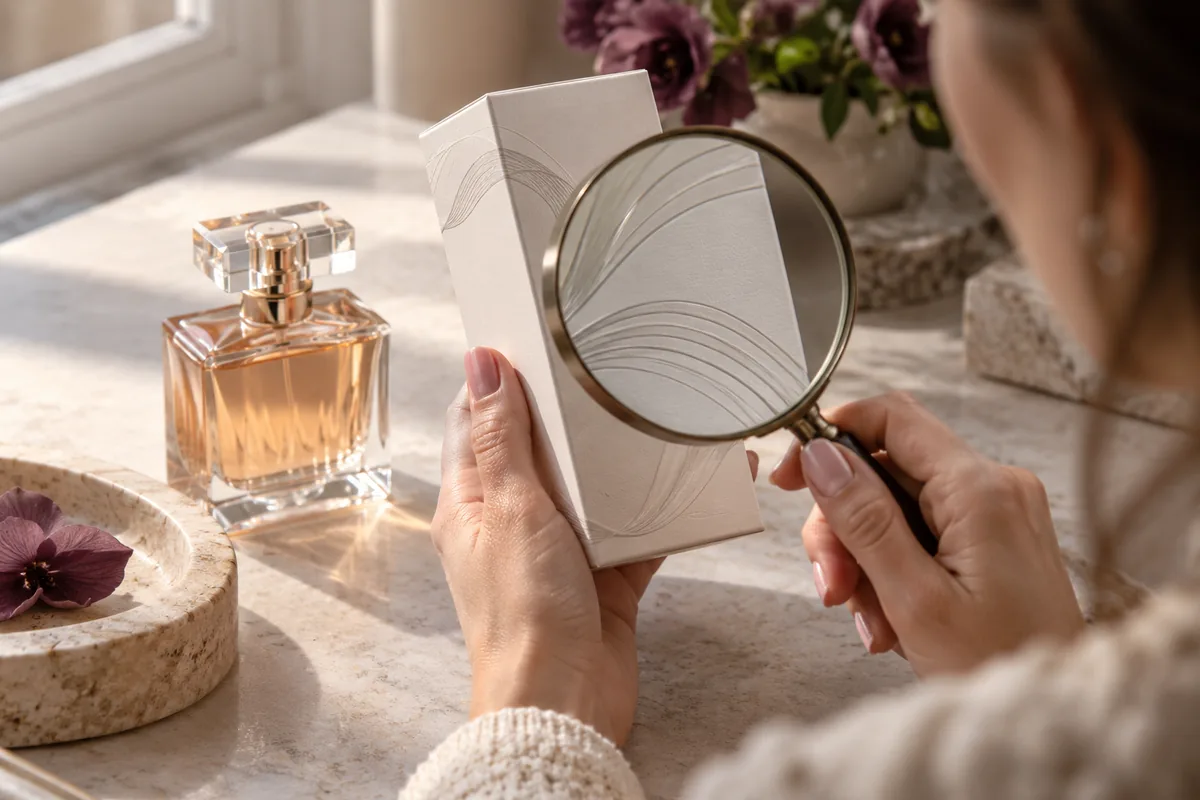
Copy the exact name and look it up in CosIng. Listing provides reference information, not permission for every use. Commercial synonyms may not identify a substance reliably.
Consider the whole formula
EU lists generally follow descending weight at addition; ingredients below 1% may appear in any order after those above 1%. Position alone cannot reveal concentration. A highlighted ingredient is not the whole formula.
Compare like with like
Note intended use, texture, instructions and known exclusions. Use these together. A long list, unfamiliar name or natural origin is not an automatic verdict.
Keep a usable record
Photograph the purchased product’s list and batch number. Online ingredients may concern another version. For a known allergy, check the name provided by your professional rather than relying on an app score.
Compare two ingredient lists
Compare lists in separate columns, retaining exact names and packaging order. Mark added, removed or moved names without assigning benefits. A changed name may need nomenclature clarification; ask before concluding reformulation.
Find a substance in CosIng
CosIng also supports searches by CAS, ELINCS or EINECS number. Distinguish active entries from historical data; the database is informational and has no legal value.
Two special markings: “nano” and “+/-”
In the EU, an ingredient present as a nanomaterial is followed by “nano” in brackets. For makeup sold in several shades, “may contain” or “+/-” can introduce colourants used across the range. The list may therefore cover more than your particular shade. For a targeted check, give the manufacturer the product name, shade and a photograph of the label.
Read the whole name: four examples to keep separate
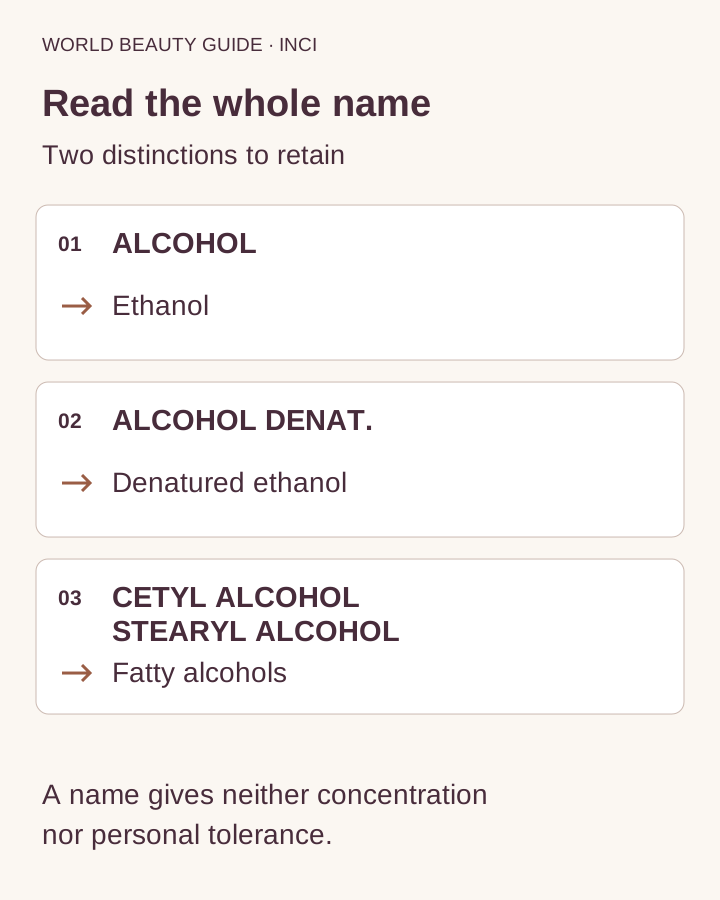
CETYL ALCOHOL and STEARYL ALCOHOL are fatty alcohols; ALCOHOL on its own means ethanol in the FDA’s explanation. ALCOHOL DENAT. denotes denatured alcohol. Likewise, UREA and HYDROXYETHYL UREA are distinct ingredient names. Searching only for the fragment “alcohol” or “urea” loses these distinctions. Copy the complete name before consulting its reference entry; identifying a family does not assess your tolerance or the finished product.
Check the name in the current EU glossary
Since 30 July 2026, Decision (EU) 2025/1175 has replaced Decision 2022/677 for the EU glossary of cosmetic ingredient names. Use the glossary to look up the label name. To check the conditions of use for a substance, consult the Cosmetics Regulation and its annexes.
Worked example: similar lists do not prove equivalence
Take two fictional excerpts: A begins ‘Aqua, Glycerin, …’; B begins ‘Aqua, …, Glycerin, …’. They establish only that Glycerin appears in both lists, not its exact concentration or the finished products’ results. Compare exact reference, stated use, directions and a photograph of the packaging list. Keep names in their original order. An ingredient not shown in a partial photograph is ‘not visible’, rather than ‘absent’. This prevents a full list being compared with a cropped image as if both were complete.
Match the source to the question
An ingredient entry explains a documented function; packaging identifies the purchased version; the manufacturer can clarify an unpublished concentration or reformulation. These answer different questions. A function description does not confirm a commercial claim, and a translated name does not replace INCI. For an identified allergy, keep the name supplied by your professional and seek suitable advice if uncertain. Reading can usefully produce a precise question without requiring a purchase or a global verdict on the formula.
| Name copied from label | Useful distinction | What the name does not reveal |
|---|---|---|
| UREA | Distinct from HYDROXYETHYL UREA | Product concentration and pH |
| CETYL ALCOHOL | Fatty alcohol; distinct from ALCOHOL | Personal tolerance |
| STEARYL ALCOHOL | Distinct from CETYL and CETEARYL ALCOHOL | Finished-formula performance |
Put it into practice
An editorial planning method to adapt to your situation.
| Situation | Observe or ask | Next step |
|---|---|---|
| Name absent from an online listing | Photographed list and purchased version | Ask the manufacturer to confirm correspondence without freely translating the name |
| Highlighted ingredient | Exact list name and scope of claim | Separate presence, known concentration and advertised result |
Your checklist
Frequently asked questions
Does CosIng approve products?
No. It documents ingredients rather than certifying finished products.
Do similar lists prove identical products?
No. Proportions, processes and packaging can differ.
Sources & references
 Cosmetic ingredient database · CosIng European Commission
 Understanding the label Cosmetics Europe
 Regulation (EC) No 1223/2009, Article 19 EUR-Lex · European Union
 Alcohol Free FDA · United States
 Final report of the safety assessment of Urea CIR · Int J Toxicol · PubMed
- Safety Assessment of Hydroxyethyl Urea as Used in Cosmetics CIR · Int J Toxicol · PubMed
- Decision (EU) 2025/1175 · Glossary of common cosmetic ingredient names EUR-Lex · European Union
 Vente en ligne de cosmétiques : la liste des ingrédients doit être affichée DGCCRF · France
Understand ingredients and materials

Retinol
A form of vitamin A listed under the INCI name RETINOL.
Explore ↗
Glycerin
A common humectant identified by INCI GLYCERIN.
Explore ↗
Dimethicone
A silicone polymer used in different cosmetic formulas.
Explore ↗
Sodium hyaluronate
A hyaluronic acid salt identified by SODIUM HYALURONATE.
Explore ↗
Niacinamide
NIACINAMIDE identifies nicotinamide.
Explore ↗
Niacin
NIACIN identifies nicotinic acid.
Explore ↗
Squalane
SQUALANE: chemical identity C30H62.
Explore ↗
Squalene
SQUALENE: chemical identity C30H50.
Explore ↗
Urea
UREA: an ingredient with humectant and conditioning functions.
Explore ↗
Hydroxyethyl urea
HYDROXYETHYL UREA: a humectant distinct from urea.
Explore ↗
Cetyl alcohol
CETYL ALCOHOL: a fatty alcohol distinct from ethanol.
Explore ↗
Stearyl alcohol
STEARYL ALCOHOL: a fatty alcohol identified as 1-octadecanol.
Explore ↗Beauty directory
Brands, online shops and beauty magazines: explore their official websites and areas of focus.